Detect Drones Earlier. Suppress False Alarms. Cut Review Costs.
SkyGuard fuses RGB cameras, thermal infrared, acoustic spectra, mmWave radar, and RF metadata into one decision-support platform — designed to minimize false alarms and operator fatigue at a fraction of enterprise system costs.
Detection Demo
TU001-R3 RGB + thermal fusion — late-fused detections on Anti-UAV-RGBT sequence.
The Challenge
Current Drone Detection Falls Short
Single-sensor systems produce too many false alarms. Enterprise solutions cost too much. And in Canada, active countermeasures are prohibited by law.
False Alarms Drain Operators
Single-sensor systems confuse birds, aircraft, and clutter with drones — generating hundreds of false alerts per shift. Every wasted review wastes budget and erodes trust.
Enterprise CUAS Is Unaffordable
Military-grade counter-UAV systems cost hundreds of thousands of dollars. Critical infrastructure operators — airports, utilities, prisons, events — need a lower-cost alternative.
No Single Sensor Is Enough
RGB cameras fail at night. Acoustic sensors are drowned out by wind. Radar struggles with small targets. RF is blind to RF-silent FPV drones. No single modality covers all scenarios.
Jamming Is Illegal in Canada
ISED prohibits RF jamming devices without exemption. Any legitimate Canadian product must be passive — focused on detection, classification, alerting, and human review support only.
Sensor Fusion
Five Modalities. One Coherent Picture.
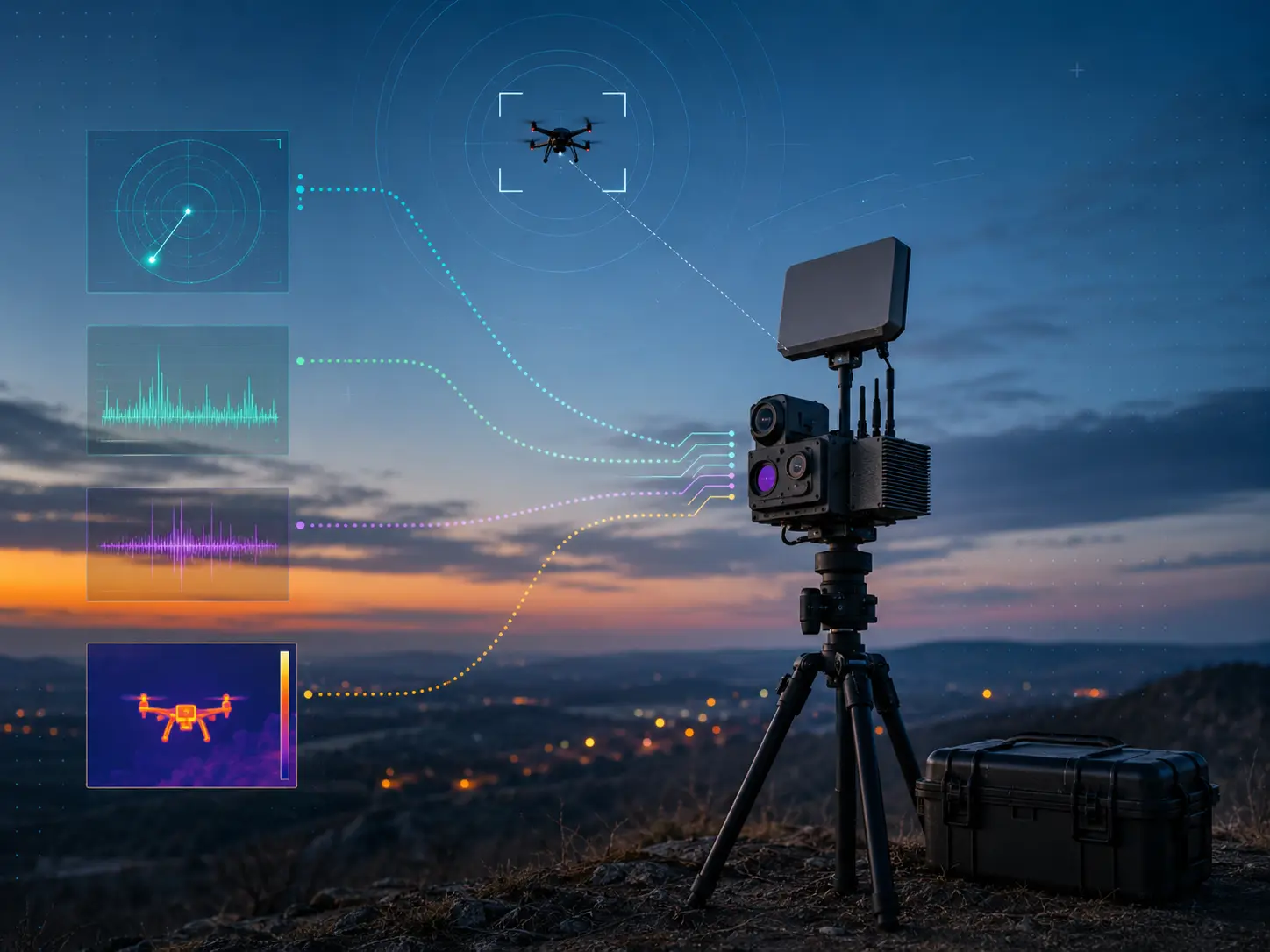
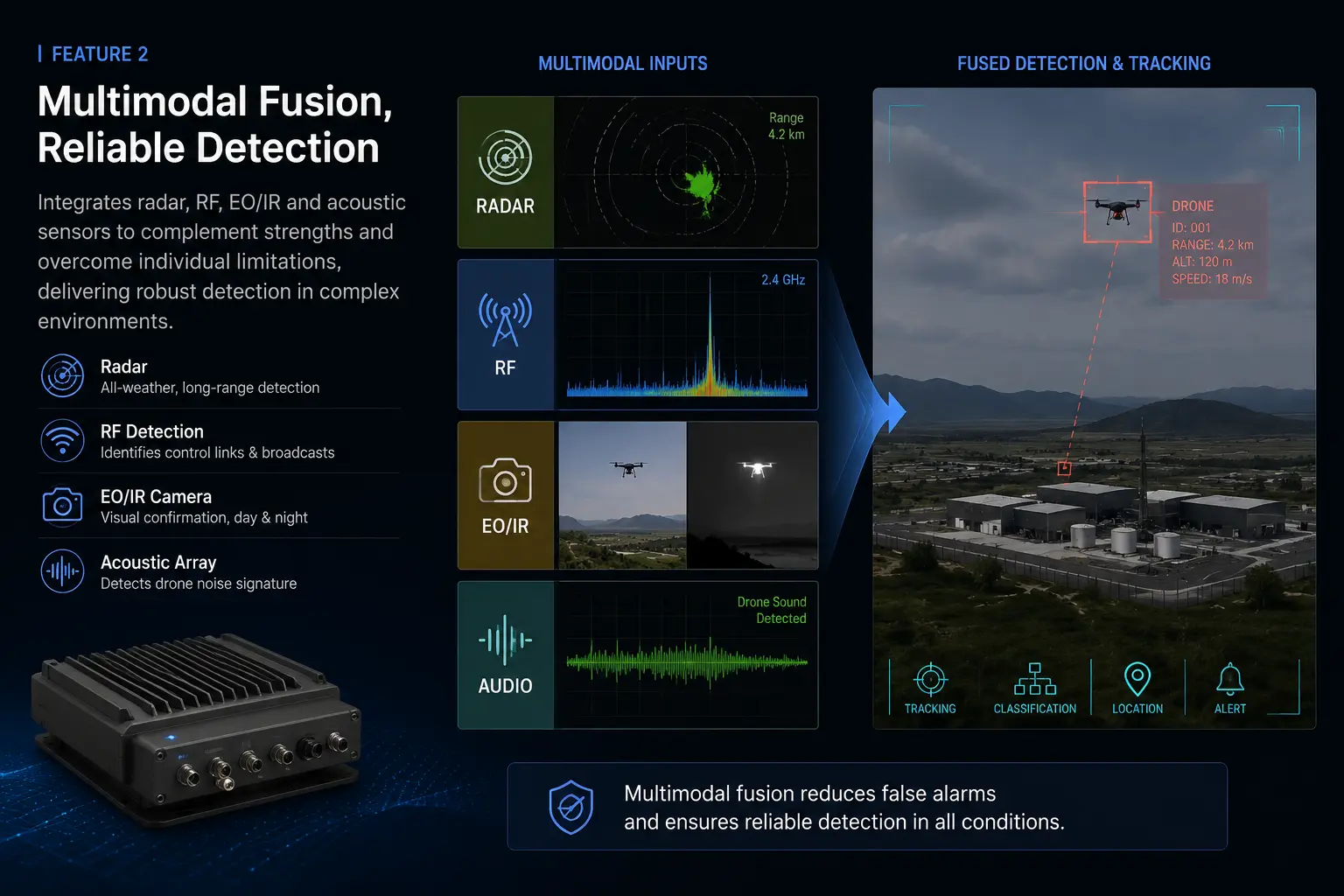
No single sensor covers every scenario. SkyGuard combines five complementary modalities and adapts weights dynamically to match operating conditions — day, night, rain, wind, or RF-silent threats.
RGB Camera
Primary visual detection & classification
Thermal Infrared
Night & low-light tracking via heat contrast
Acoustic Spectrum
Low-cost rotor-sound cue
mmWave Radar
Range, velocity, and track continuity
Passive RF / Remote-ID
Protocol-presence metadata cue (receive-only)
Confidence-Weighted Fusion
Each modality's weight adapts automatically — lower RGB weight at night, lower acoustic weight in high wind, higher radar weight when strong tracks exist. The system keeps working even when sensors are missing or unreliable.
Core Innovation
5-Layer False-Alarm Suppression
Most CUAS systems optimize for detection rate alone. SkyGuard treats false-alarm suppression as the primary engineering goal — because false alarms cost money, erode operator trust, and make systems unusable in practice.
Negative-Class Training
Birds, aircraft, insects, clouds, wires, and site-specific clutter are trained as explicit negative classes — not just absent positives.
Temporal Persistence
A detection on a single frame does not trigger an alert. Targets must persist across N-of-M frames or maintain track confidence above threshold.
Cross-Modal Confirmation
Alerts are promoted only when independent modalities agree — e.g., an RGB track corroborated by an acoustic drone-like spectrum or a radar velocity cue.
Contextual Plausibility
Speed, acceleration, trajectory smoothness, geofence zones, and approach direction filter implausible detections — while remaining robust to fast FPV drones.
Human-Review Triage
Three alert tiers: low-confidence events are logged silently; medium-confidence joins a review queue; high-confidence triggers an active alert — drastically reducing operator burden.
Development Roadmap
A Staged R&D Program
We follow a rigorous, evidence-based path from public dataset baselines to Canadian field validation — so every claim is backed by real measurements.
Single-Modality Baselines
Establish honest per-sensor detection rates, false alarms per hour, and operational metrics on public datasets (Anti-UAV, DroneRF, MMAUD, Drone-vs-Bird).
Canadian Field Dataset
Collect site-specific data: drones, birds, FPV targets, day/night/rain/snow, urban and industrial backgrounds, with certified pilots and privacy controls.
Multimodal Fusion & Validation
Compare sensor combinations at a fixed 90% detection rate. Measure false alarms per hour, first-alert time, track continuity, and annualized cost per coverage area.
Use Cases
Built for Real Operational Environments
SkyGuard is designed for organizations that need affordable, reliable drone detection — not multi-million-dollar military platforms.
Airports & Airspace
Protect approach corridors and perimeters from unauthorized drone intrusions with 24/7 passive monitoring and low false-alarm rates.
Energy Infrastructure
Monitor pipelines, substations, and wind farms against drone surveillance and sabotage threats — day and night.
Industrial Sites
Secure refineries, mines, and construction zones with scalable sensor configurations tailored to site budget and terrain.
Public Events
Temporary deployments for stadiums, concerts, and government gatherings where drone intrusions create safety and security risks.
Government Facilities
Border crossings, prisons, military support zones, and parliamentary precincts requiring compliant passive detection solutions.
Remote & Rural Monitoring
Low-cost RGB + acoustic configurations for sites where wired power and high-bandwidth connectivity are limited.
Honest Evaluation
We Measure What Actually Matters
mAP alone is insufficient for operational systems. A detector can score well on curated frames while still generating hundreds of false alarms per hour in continuous video. SkyGuard evaluates every sensor combination on operational metrics — at a fixed 90% detection rate, across real Canadian conditions.
Research Foundation
Built on Peer-Reviewed Evidence
Every sensor choice and fusion method is grounded in published literature and validated public datasets — not vendor marketing claims.
Anti-UAV
318 RGB-thermal video pairs with bounding-box ground truth across diverse scenes including buildings, clouds, day/night conditions.
RGB-T fusion baselineMMAUD (ICRA 2024)
Time-synchronized stereo cameras, mmWave radar, 4-node audio array, and 3D LiDARs — purpose-built for multimodal anti-UAV research.
Multimodal fusion validationDroneRF
RF recordings from three drone models in multiple flight modes with background RF baselines for drone detection and classification.
RF sensing baselineDrone-vs-Bird (WOSDETC)
IEEE challenge dataset targeting drone alarms without false bird alarms — directly addressing the most common false-positive source.
Drone/bird discriminationDDL Audio Dataset
Multi-channel audio dataset for drone sound detection, classification, and localization. IEEE MLSP 2025.
Acoustic classificationRadar/RF Dataset
Time-synchronized FMCW radar, CW radar, and passive RF receiver data for drone detection research.
Radar track baselineDesigned for Canadian Compliance from Day One
- ▸ISED-compliant: SkyGuard is strictly passive — no RF jamming, spoofing, or active countermeasures. All receive-only RF sensing uses only lawfully available spectrum data.
- ▸Transport Canada: Field data collection follows Canadian Aviation Regulations Part IX with certified pilots, site risk assessments, and airspace coordination.
- ▸PIPEDA / Privacy: Audio is processed as spectrograms or extracted features — raw audio is not stored. Camera coverage is scoped to minimize capture of private spaces.
- ▸IDEaS-aligned: Research approach is consistent with Canada's IDEaS Counter-UAS challenge, which funded passive multi-sensor and acoustic detection concepts.
Early Access
Join the Pilot Program
We are seeking early-access partners from airports, utilities, industrial operators, and government facilities to co-develop and validate SkyGuard at real sites. Reach out to discuss your detection needs and operating environment.